Tuesday, 11 February 2014

“The bells! The bells!” or ‘On the Wish to Ward Off Evil’


Nearly a thousand years ago, in the 1070s, a 70’ long piece of embroidered cloth we now call the Bayeux Tapestry was commissioned by William the Conqueror’s half-brother to depict the events leading up to the Norman Conquest. One section shows the funeral of Edward the Confessor, who died some months before the Battle of Hastings in 1066 (And All That). If you look carefully at that scene, you’ll find - down at the bottom  - two people carrying bells in each of their hands.
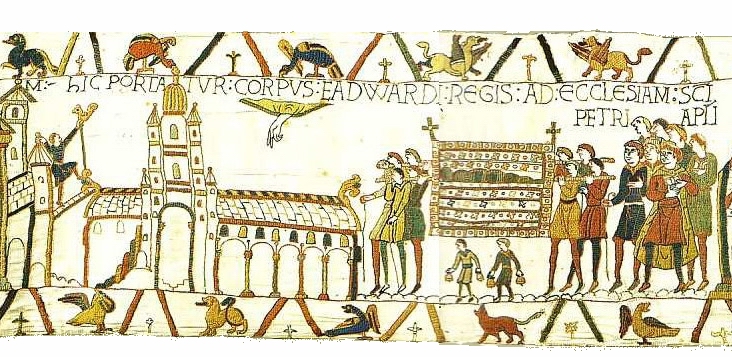
File:BayeuxTapestryScene26.jpg
The use of bells in religious ceremonies goes back a long way, in the West at least to ancient Rome. And not just religious ceremonies. For many cultures around the world from time immemorial have used bells to ward off evil spirits: in India and China and Japan they used them alongside wind chimes.  And the scene in the Bayeux Tapestry might well be part of that tradition, the folk belief that evil could be averted by frightening it off, so to speak, with bells. Wedding bells too, in Christianity, belong in this tradition: they announce, and celebrate, the couple – but they also ward off the evil that was felt to lurk whenever joy is present.

These thoughts are prompted by a curious detail in this week’s Torah text. The robe of the High Priest, worn when he was performing his cultic duties, is described in elaborate detail in Exodus 28. It includes the instruction that his robe was to be adorned with bells on its hem (verse 35) – “and the sound shall be heard when he goes in to the holy space, before the Eternal One, and when he comes out, v’lo yamut”, (literally, ‘so that he does not die’). Archeologists in Jeruslaem have recently discovered such a bell near the Temple Mount.  

The Golden Bell
 
As so often in the Torah, there’s no explanation given for these mysterious bells. They can hardly be there out of a worry that the High Priest would get lost – it’s not the sort of bells we put round  a domestic cat, or the Alpine bells round the necks of cattle or sheep or goats.  A traditional explanation suggests that it could have been an announcing bell so that people would know when the High Priest was entering the Holy of Holies for the sacred business of communing with the Divine – a bit like the one that begins and ends that other sacred activity, the opening and closing of the New York Stock Exchange.  Or perhaps, like the pomegranates that also adorned the hem of his robe, a symbol of the fruitfulness of religious life, the bells were symbolic – representing connectedness with the divine, a connectedness that goes beyond words.  
Or perhaps it is evidence - to go back to the Bayeux Tapestry - of that ancient belief that ringing bells can ward off evil?  Don’t we all wish, profoundly wish, that we could keep ‘evil’ away - stop bad things from happening - just by ringing a bell? Whether it is ringing a bell, or spitting three times (p,p,p), or stroking a rabbit’s foot, or not walking under ladders, or wearing an amulet blessed by a wonder rabbi (or by the Kabbalah Centre), or any one of a hundred thousand folk customs that have arisen in all ages and all places on the planet – how amazing life would be if there could be a straightforward link between an action we take (something we do, or say, or wear, or pray) and the warding off of unpleasant, unhappy, upsetting, disturbing events,  things that are part of the weave  of life but cause us misery, pain, distress.
Beneath our rational selves, and our conscious, modern minds that might describe all of these things as superstitions, as attempts to control life in all its uncontrollable randomness, deep in us we can probably locate a primitive emotional need to believe that we might have some way of controlling our fate, of doing something that might prevent a disaster, or an accident - for ourselves, or those we love. Harm can be avoided, we believe (we desperately want to believe), if only I’m good enough, or pious enough, or superstitious enough, or careful enough.
What we humans can’t bear, don’t seem to be able to bear - and our culture colludes in this in all sorts of ways -  is the sheer contingency of life, its messiness, its unpredictability, its randomness, its haphazardness. You can get into your car and if you are in the wrong place at the wrong time, you know that, through no fault of your own, that you can be in an accident. It can shake you up, it may even kill you – heaven forbid. And we say ‘heaven forbid’ – or p,p,p as my grandmother would do - as a prophylactic: as if just by saying those two words it could stop it happening. Or the parallel belief that if we don’t say it, it might happen:  because now we have thought it, it just could happen and we’d have brought it into being just by thinking it. We tie ourselves in knots because if, in the end, what happens to us is out of our control – that knowledge is unbearable, the feelings of helplessness are unbearable.  
We would all do anything to avoid  these kinds of random events happening. We would love to know how we can avoid distress and pain - but we  can’t, and some part of us knows we can’t, knows that life is not organized like that: even our bodies themselves are part of that contingency sown into the fabric of life. We know our bodies  are fragile, vulnerable, and we can look after them as much as we can, eat the right things, exercise them, take care of them - but they still let us down in unpredictable and uncontrollable ways.
Being an embodied human being is a daily lesson in the essential fragility of our humanness – and our mental  states too are equally as vulnerable, however much we might meditate, or medicate, or practice mindfulness, or however many years of therapy we might have had.
Bad stuff happens. And no bell ringing will make a difference. We are not that omnipotent – even though lodged in us is an irrational belief that we are: that we can manage our fate by just taking the right precautions; or having the right security systems in place, in our homes, or synagogues, or computers; or just following the right Health and Safety guidelines, or having the right child protection schemes in place. One very modern illusion – a deeply needed belief, but an illusion – is that we can legislate our way to happiness by removing distress, or just alleviating the possibility of distress; that we can have systems and laws to stop bad things happening to us, or to our children, or to ‘the vulnerable’ – although we are all vulnerable. That is of the essence of our humanity: our vulnerability, our mortality, – “never send to know for whom the bell tolls; it tolls for thee” (John Donne, ‘Devotions Upon Emergent Occasions’, 1624).
So although we don’t know – can’t know – the purpose of the bells on the High Priest’s robe (the Talmud discusses whether there were 36 or 72 of them), what we read is that these bells, on this garment, were a matter of ultimate concern in the scheme of things. The Hebrew text intuits that what was going on in these arcane rituals was a matter of life and death. He was to wear these bells v’lo yamut, (‘so that he does not die’).
But maybe we can understand this phrase figuratively, and existentially. I prefer to think that the wearing of these bells was v’lo yamut  - ‘lest he stops living in the moment’. By which I mean that these bells kept him alert, kept him awake, moment by moment, every step of the way, every movement of his body, even as he breathed in and out, as we all breathe in and out, the bells kept him alive to the mystery, the awesome nature of being alive now, as we are alive now – though we have no bells to remind us that this is a thing of awe: human life, in all its fragility and vulnerability, all those cells, all that DNA, all that drama of heart and lungs, liver and kidneys and bones and brain, all that ‘three pounds of jelly’ (as Oliver Sacks, with well-tempered irony, describes the brain ) through which everything flows and filters...what are we to make of it all, this body of ours, this mind of ours, with its memories, its feelings, its knowledge, alongside its limitations, its failures, its fading powers? We have nothing as simple as a bell to remind us of the awesome nature of life, daily life, our life, our being here now.
The bells kept the High Priest attentive to the mystery of being, at every moment. Now and now and now. And this, I would suggest,  is the holy space he entered – this awareness of the present moment in all its kedushah, its unfolding holiness of being . The Torah text gives us a picture not just of an archaic ritual that has disappeared into the mythic past – but a picture of our inheritance, we ‘kingdom of priests’ (Exodus 19:6). When we read of these bells  we turn our inner ears to the music of the present moment - we are the priests whose task it is to enter into the presence of the sacred: this music of the sacred, in each moment, is sometimes so soft we can hardly hear it, it’s sometimes so quiet we forget to hear it, it’s sometimes so faint we think there is nothing there.
We need to be reminded, every day, twice every day – Shema Yisrael, ‘Hear O Israel, Listen out Yisrael’, when we go out and when we come in, the bells of the High Priest are still to be heard, each moment, reminding us of the holiness of life itself. And if we don’t attune ourselves to listening in – it is as good as being dead. This is the sacred drama of a kingdom of priests, our daily drama, life-giving, life-preserving: it is within the randomness of life, that holiness is to be found.
The more time we spend trying to control life to avoid bad things happening, the further we get from contentment. We can drive ourselves, and others, mad If we cannot embrace life as – in the final analysis – uncontrollable, as uncontrollable as those bells on the hem of the High Priest. Every moment he moved, they sounded. Every moment he moved they reminded him: you are alive now, and this is sacred. However still you are, you will hear the bells, faintly, the background to life. It’s when you stop hearing the bells, when the bells stop – that’s it, that’s the end of your life. The dead don’t hear the bells. They are for the living, and for life.  Shema Yisrael.
[based on a sermon given at Finchley Reform Synagogue, February 8th, 2014]

Tuesday, 28 January 2014

The Burden and Blessing of Being a Jew

There are moments when I suddenly get a glimpse of how counter-cultural Jewish ritual and synagogue life actually is. Take the weekly reading from the Torah scroll. Reading that parchment text, written lovingly by hand according to special rules, is not the same as reading it from an iPad – handling that scroll reminds me how far away (emotionally, practically, intellectually) is that ancient world out of which those Hebrew texts come.  The texts have never changed – but everything else has.

After 2500 years, how is it possible – is it indeed possible? - that the values of that long-disappeared world rooted in the agricultural and village life of a small God-fearing Middle Eastern tribe are connected to us today in the globally inner-connected, urban, sophisticated (or so we like to think) technologically-driven world we live in, where religion is just another life-style choice?
Yes, these ancient Hebrew texts have been foundational in different ways to three great religious traditions, but when we hear – as we did this week - about laws for damage to livestock, or damage to crops, or laws about suppressing magic, or laws relating to the seduction of virgins (Exodus 22 and 23), we know we are reading about a long-gone world, where how people lived and thought and behaved were, we imagine, very different from our own.
It’s not that legislation about animal welfare, or food production, or a fascination with magic and superstition are not still part of our world – far from it – let alone emotionally-charged questions around sexuality and the relations between men and women (just ask Lord Rennard): all of these aspects of life are recognisably contemporary and still filled with moral and ethical choices, just as they were in days gone by.
But it still requires an imaginative leap, or an effort of will, or both, to link the world of then with the world of now. Then suddenly a verse leaps out at you, transcending time and space: “You shall not oppress a stranger, for you know the feelings of a stranger, having yourselves been strangers in the land of Egypt” (Exodus 23:9).  
We know this comes 36 times in the Hebrew Bible. It is like a chorus, a repeated refrain in the Biblical symphony. ‘You shall not oppress a stranger – someone who is different from you – because you know what it is like from your own history, your own story, your own collective experience, to be treated badly just because you are different’. Perhaps the repetition is because it is so difficult to adhere to. And that it keeps slipping out of sight.  Or perhaps the repetition just reminds us that this is the cornerstone of Judaism, its belief in justice, in social justice.
But when we stumble across it in the midst of the oxen and asses and virgins, suddenly all that gap between Middle Eastern life of three millennia ago and 2014 disappears. Because we recognise that there is a human reality to suffering, and oppression, and victimisation, that is universal and timeless.  There is something lodged deeply in the human heart, the human psyche,  that has always wanted, and still wants,  to reject people not like ‘us’ – those who look different, speak differently, think differently, act differently. As well as something in the - in some - human hearts that recognises that this isn’t right, it isn’t just, that we are – or should be, or could be – bigger than that, better  than our meaner selves, our more frightened selves, our more narrow-minded or callous selves.
The Hebrew Bible recognises the universal nature of this inner battle in the human heart and soul – between our capacity for empathy and generosity and kindness, and our capacity for selfishness, and mean-spiritedness, and turning our back on others not like ‘us’. It recognises – it keeps coming back to - this timeless inner human battle and tries to nudge us towards our better selves, that part of us able to care for others, that part of us that knows that kindness and generosity might not always be what we feel, but that kindness and generosity are nevertheless how we are meant to act if we are to live together – and thrive - in any society. 
We don’t really need a Holocaust Memorial Day to remind us of the centrality of this message. Germany in the 1930s is still a cultural memory for Jews, when a whole society became caught up in the delusional state of mind that believes the exact opposite of what the Hebrew Bible insists upon. It was a state of mind that considers that the stranger, the outsider, is a threat, a danger – and whether the so-called outsider is a Jew, or a Jehovah’s Witness, or a Quaker, or Romany, or mentally handicapped, or a homosexual, or  a communist – the fascistic mental world that dominated  the 1930s (and we still hear echoes of it today – only the ‘other’ might be Romanian or Bulgarian), this mental world  says that ‘you’ are not connected in your humanity to ‘us’, we don’t want you here, we don’t want you living with us; we cannot tolerate you in your difference so you need to be oppressed, we need to institute laws that oppress you, discriminate against you, make your lives intolerable. And  in Germany, eventually, the ‘final solution’ to difference: maybe it’d be better just to get rid of you completely, kill you off.
So we all know where the failure to heed the demand ‘You shall not oppress a stranger’ can lead if it isn’t foundational to how a society organises itself. Today’s secular language of human rights, of equality and justice, emerged out of this Biblical vision of how we are to live with each other in society. From those early books of the Bible onwards, through the prophets of Israel, up to Rabbi Abraham Joshua Heschel marching arm and arm with his friend and colleague Dr Martin Luther King in Alabama in the 1960s, this passion for justice has been at the very core of authentic Jewish faith, Jewish life. Because without this vision, this ethical  demand, religion is hollow, religion is meaningless, religion is hypocritical.
The Taliban’s attack on Malala Yousafzai is an example of  where religion becomes perverse: when it attacks or oppresses other human beings for being the wrong gender, or sexual orientation, or belonging to a different religious tradition, or even a different variety of the same religious tradition: Sunni and Shi’ite, Protestant and Catholic, Orthodox Jews v Reform Jews. Religion becomes toxic when it loses touch with its central ethical core, the concern for someone different from me, and particularly the outsider, the stranger, the immigrant, the asylum seeker, the marginalised, the dispossessed, the poor, those who can’t keep up with the bustle and pressures of everyday life.
One of the most heartening things of the last 12 months has been the emphasis by the new Pope, Francis, on social justice as the cornerstone of Catholic faith. He’s turned away from issues about contraception and abortion and what people do in private and has re-focussed attention on the poor, the deprived, on the need for Christians of faith to live out in everyday life that bias towards the marginal and the outsiders that was at the heart of Jesus’ teaching, teachings which show just how faithful Jesus was to his Jewishness, just how rooted he was in the essence of the faith of the Hebrew Bible.
The election of Francis last year coincided with the election of ex-oil industry insider Justin Welby as the new Archbishop of Canterbury, who has brought a breath of fresh air into the Church of England with his critique of payday lenders such as Wonga; and his questioning of the power of the International Monetary Fund and the World Bank: “It comes back to human flourishing and human fallibility. We need to recognise the latter, and design our institutions to contain it in order to ensure the former...The fallibility of human beings and thus of human institutions is a necessary part of understanding any governance structure and any centre of power. Power has to be constrained.”  
Judaism has absolutely no monopoly on the ethical demand that social justice should be at the heart of any society that wants to flourish, that wants to create the greatest sense of wellbeing for the greatest numbers.  That ancient vision has been taken on, and taken over, by all sorts of other religions and secular philosophies. But Judaism, the wellspring of that vision, needs to re-find its voice, and its spokesmen and spokeswomen. One of the sad things I found about the last Chief Rabbi was that in spite of his intellectual brilliance as a presenter of Judaism – a special ability to show to Jews and the wider public something of the richness and glory of Jewish faith, Jewish culture, Jewish civilisation - he never really spoke out on the ethical and moral  issues of the day. He had nothing to say on poverty and homelessness, nothing to say about the moral scandal of living in a society which is one of the most unequal in the western world, nothing to say about the economic assaults on the disadvantaged that have been going on these last few years.
Speaking from out of the beating heart of the Biblical and rabbinic tradition, he could have addressed from a religious perspective the class war that we are enduring, masterminded by the privileged, where the gap between rich and poor is growing ever larger.
Isn’t this the job of religious leaders – to offer an alternative moral vision to the dominant political ethos of the day, when that ethos contradicts the essential religious vision of the dignity and worth of each human being? But his failure is symptomatic of what the cultural critic Stefan Collini has described as ‘a wider unease at the very idea of  an unembarrassed appeal to non-economic human values in public debate.’ But without that appeal to other values we all become bystanders  to ‘the wanton mutilation of our life-sustaining social fabric by those who act as though balance sheets end all arguments.’ (Times Literary Supplement, January 17th)
The religious work of enacting  the moral vision, the Biblical vision, of how people should treat each other – with dignity and a radical concern for their individual well-being - is ethics in action. It is practical tzedakah – not ‘charity’, as it is often translated, but ‘righteousness’, right action:  doing the right thing, not the convenient thing. ‘Righteousness’ is a demand, , and it is easy to duck out of, or rationalise as not making a difference. But righteousness always makes a difference. Although we know how hard it is to be true to it.
It is always easier to look away, in large things and small things. Whether it is the ongoing agony of Syria, or the victimization of Palestinians or – closer to home – the attacks on the welfare state, or the demonization of the so-called ‘feckless’ poor or immigrants, all societies can let their better ethical and moral vision of human dignity go into eclipse. It happens slowly, slowly, until you realise it’s disappeared and your whole society has lost its ethical core. Though sometimes it happens in the blink of an eye, with one click on a computer keyboard, or with the stroke of a pen signing off on some further piece of life-sapping legislation by a politician or bureaucrat.
Reading from the Torah scroll keeps our eyes open, and our hearts from hardening. Reading from the Torah scroll, we strengthen each other in keeping that ancient vision alive. Reading from the Torah scroll, we are reminded what it means to carry this strange burden – and blessing – of being a Jew.  
[loosely based on a sermon given at Finchley Reform Synagogue, January 25th 2014]

Monday, 20 January 2014

Looking Forward, Looking Backward - and Looking Upwards

“I try to avoid looking forward or backward, and try to keep looking upward” (Charlotte Bronte). Bronte’s mother died when she was five, so looking back might indeed have been painful – but her view was perhaps more likely to have been informed by her Christian faith. On first glance I was struck though by how counter-intuitively different this is from what one could call a ‘Jewish world view’.  

Judaism is filled with backward-looking. We are encouraged to do this all the time. We even have a day in the year dedicated to it: Rosh Hashanah, Yom HaZikkaron, the Day of Memorial, the day for remembering the past year, and looking back over it. Zikkaron, memory, remembering, looking backward, is a huge element in Jewish life, whether religious or secular. That is what the annual yahrzeit is for, keeping alive the memory of those we have lost; we have the memorial service yizkor on Yom Kippur and the pilgrim festivals; ritual life is structured round looking back, keeping memory alive.
Jews are the great people of memory, of looking back, of recording and counting and memorialising. It is there at every turn in the liturgy: “God of our ancestors”, “the one who redeemed us from slavery”, “renew our days, as of old”. Every Friday night when we say kiddush over the wine we come across that special phrase, inserted into many disparate liturgical texts, “zecher litziat mitzrayim”: ‘in memory of the coming out of Egypt’. The 10 Commandments – which are part of our Torah readings this week - begin with a call to look back: “I am the Eternal your God, who brought you out of the land of Egypt”. This is a significant difference from the first commandment in the Christian tradition, which starts with our second commandment about not worshipping other gods. Our first commandment – and it is not even framed in the form of a demand - is to root yourself in the past, in the saga, the myth, the history, the multi-generational story of the Jewish people. All this seems far away from Charlotte Bronte: “I try to avoid looking forward or backward, and try to keep looking upward”. 
I’d go so far as to say that Jews are obsessed with the past: it can be the far distant past of the tradition, or the near distant past. The Holocaust is always sitting on our shoulder, and the mantra ‘Never Again’ is the so-called lesson to be learnt from that past: whether it is Jewish self-perception here in the UK, with the constant anxiety about anti-semitism (in other words a repletion of the past)  or whether it is Israeli politics which is deeply entrenched in a Shoah-dominated world view (or at least uses – some might say misuses- the Shoah as a rhetorical tool in its armoury), Jewish life is soaked in looking backwards, remembering its history.
Sometimes our view of the past is that it is soaked in horrors; at other times the looking back might be experienced almost as the opposite - as a golden age. People go misty-eyed at the world of yiddishkeit, an era when Jews were poor but happy; we are great nostalgists for lost worlds of community gatherings, family simchas, frum grandparents - it’s all myth-making but a lot of it still goes on, that harking back to earlier times. We are skilled at retreating from the complex demands of the present into stories: fables about Jewish life as it was, as we imagined it was, as we airbrush out the cruelties, the sadnesses, the divorces and the affairs,  the sitting shiva if someone God-forbid married out, the domestic violence (physical and emotional), or those who didn’t marry, or couldn’t conceive:  painful lives far from the cosy fantasy of generation following generation, each link in the chain filled with good memories. Jewish nostalgia suffuses the past  with a rosy glow. But it is  a cover-up job. That kind of nostalgia is a kind of backward-looking for the deluded. And I guess most of us Jews do it to some extent, but I have learned to try to treat it with caution.
And what about looking forward? Where does that figure for us? Where and how do we collectively look forwards? The texts we are reading in the Torah cycle at the moment will be dominated by one motif: the image of the journey to a promised land, the land flowing with milk and honey - a sort of nostalgia projected into the future; the garden of Eden renewed at the end of the journey, over the horizon, in the future, always waiting for us beyond the wilderness - but always just out of reach. And then there is the figure of the Messiah, who comes at the end of days, prayed for every day by the devout - the Messiah and the Messianic age being the most powerful  myths in the tradition that point us towards the future, keeping hope alive.
Consider too those phrases we read this week from chapter 19 of Exodus:  “You shall be for Me a kingdom of priests and a holy people”, a “treasured possession” (19:5/6) – they are thrilling, daunting, challenging words. But they point forwards. Yes, they make us feel special, wanted, important in the scheme of things; they are part of the foundation of how Jews have thought of themselves over the generations, part of that complex and fraught and disputed sense of ‘chosenness’, they speak about Jews as distinctive, as incarnating something different  from other peoples, a difference with a meaning, a difference with a demand, a task, a requirement: ‘you have a job to do in the world: to bring holiness into the world through how you live, how you live with each other, how you act towards each other, and how you live with others, who are not part of ‘you’, the strangers, the outcasts, the marginal: how you live with those who are like you and how you live with those who are different from you, and how you live with the rest of creation, with animal life and with nature with the planet itself. All this – how you live, the choices you make – make you into a ‘holy’ people’.  Holiness isn’t a given: it’s work, it’s something to be achieved, enacted, in everyday life.
In other words, ‘holiness’ is a movement towards the future. It’s not about what you did yesterday, it’s not about congratulating yourself on what has been achieved: it’s about now, and tomorrow, and the day after tomorrow. It’s about something that is always just coming into being, that waits to be brought into being, by us:  it’s a restless, ceaseless, reaching into the future – to the next thing that needs to be done – a striving after acts of love and justice and kindness and compassion, a striving done in the sure and certain knowledge - paradoxical knowledge - both that this is what is required and that you can never achieve it, you can never rest on your laurels and say ‘job done’, ‘now we really are a holy people.’
Atem tihiyu li...you shall be a holy people” the Torah says (Exodus 19:6) – not “you are” such a people  – Jews face forwards, aware of what needs still to be done, aware of incompleteness, of the task ahead. We are a people who look forward, our faces turned towards the future - as well as a people who, for better or worse, look backwards.
So what is Charlotte Bronte getting at? What does it mean not to look back or forwards but upwards? I think this is more than a simple expression of piety, a way of talking about that traditional picture of looking to God, who is pictured as ‘above’ us. Because she isn’t a using metaphor about space. She is talking about time: ‘looking back’ and ‘looking forward’ is about time. So what might it mean to ‘look upwards’ as a way of orienting ourselves in time?
Again, I turn to our Exodus text. Because there a strange quirk in how Exodus 19 begins. This, we remember, is the lead up to the moment of divine revelation at Sinai, when a whole people are standing in the divine presence. And the text begins: In the third month (on the third new moon),  after the children of Israel came out of Egypt, ba-yom ha-ze, on this day, they came to wilderness of Sinai.  It doesn’t read ‘on that day’ – a day long gone, a day in history, a day that belongs to looking backward in time. But ‘on this day’. This is when the revelation of the divine happens:  it is not in the past, nor is it is not in some far off day in the future; it is on this day, today. I’m drawing on a Hasidic reading of this text, and Martin Buber’s reading of the text, both of which draw our attention to the presence of God, of the Eternal, here and now.
The promise of the Torah, read in this way, is that if we hold ourselves open in the present moment to what is unfolding now, on this day hold ourselves open  to what occurs to us, and in us, and between us – then there is a meeting, an intersection, of timelessness with time, and the Eternal One whose name is “I am” – ehyeh – is with us and in us and connecting us.
Exodus 19 verse 5 could be said to continue this theme: If you listen, listen and keep on listening [the verb is repeated for emphasis] to my voice, then you will be, become, my special treasure...  The call is for attentiveness, listening. That’s why we need some silence in our lives, and in our services, opportunities to listen to what is above us, around us, all the time – but that we might miss if we are continually looking forwards or looking backwards. Too much time spent in the past – or too much time seeking the new, looking for the next new thing – both miss the drama of spiritual life, which is happening all the time, at this moment. The revelation of the divine, of divinity, is always now, on this day. It is, so to speak, now or it’s never.
So thank you Charlotte Bronte for pointing the way, giving us the clue, counter-intuitively, to avoid too much forward looking and too much backward looking. And encouraging us to look upward, and outward, and become aware of the wondrous nature of existence, the dizzying tumultuous richness and grandeur of life on earth, unfolding moment by precious moment.
[based on a sermon given at Finchley Reform Synagogue, January 18th 2014]


Saturday, 21 December 2013

"Mandela'd Out"?

The first time I heard it, it took me by surprise. It was on the Thursday morning – less than a week after his death and three days before the funeral:  “Oh, that’s enough..I’m Mandela’d out..."  Too much attention paid, too many news hours, too many anecdotes and reminiscences, too much hyperbole, too much sanctification, too much sentimentality, too many politicians and celebrities jumping on the media bandwagon... ‘Mandela’d out’.  So it goes, so it goes...

So has everything been said now?  Is it time to move on? And consign Mandela to history, or legend, or some uneasy fudging of the two? Are we ready, as 2013 stutters towards its end, are we ready  to close the book on Nelson Mandela, leave him be in his place of rest, in the family graveyard alongside his parents and three of his children? Are our faces already turned away, scanning the horizon for the next new newsworthy thing? Maybe. Maybe that funeral, that curious mixture of the personal and the political, the tribal and the military, the fragments of Christian liturgy filled with hope for the end of days set against the landscape of Africa, where human life began, maybe that was the last chapter of this saga and we can all breathe out now that Mandela is finally at peace in his place of rest.
But I’m still musing on what that signified, that some people were feeling ‘Mandela’d out’ after less than a week. I know that wasn’t the mood at the Finchley Reform Synagogue when we held an evening that week for people to come and talk about Mandela and South Africa, about what it felt like to live under apartheid and what it meant to fight against apartheid, there or here.
Our gathering - we called it a ‘commemoration of the life and legacy of Nelson Mandela’-  didn’t attract a huge number of people, a couple of dozen maybe;  but it was a privilege to be there and listen to people’s stories, whether it was the sickening feelings of living in a racist regime, or the experience of imprisonment, or the inspiration that Mandela had generated, with his decades of perseverance, his belief that justice must in the end win out over injustice, his ability to allow some deep humane quality in him – a spiritual quality, I suppose – to transcend bitterness, or the wish for revenge, to show generosity, to act with restraint. This meant something, something noble and profound, to many of those who came and shared their thoughts and experiences. Who were definitely not feeling ‘Mandela’d out’.
Don’t we need to know, in an era of cynicism and duplicity, don’t we need to be reminded, that there is such a thing as a deeply moral, compassionately human politics?  That one person’s actions, and beliefs, can make a real difference, a difference for good?
But that ‘Mandela’d out’ reaction – and I began to hear it quite a bit as the week went on – needs an explanation, or at least it needs to be reflected on. Because I don’t think it was just an inevitable reaction to the 24/7 television news culture we live in, where the images and pundits were inescapable, and  we were flooded with Mandela stories and newspaper supplements everywhere we went. I do wonder if it was something more subtle than that, maybe more unconscious, something about the challenge Mandela’s life presents to our own lives.
Because one could have a response to his life like that voiced by President Obama, in that remarkable speech he made at the memorial gathering, when he talked about something stirring in him when he first learned as a student about Mandela’s struggles and it “woke me up to my responsibilities to others and to myself”, he said, and although, “ I will always fall short of Madiba’s example, he makes me want to be a better man. He speaks to what’s best inside us.”
And I think that is true. The narrative of Mandela’s life does give us glimpses of what it means to live true to one’s deepest values, the best, most humane, parts of ourselves. Because yes, he was a warrior, and there was something in him as hard as steel, and of course he had his flaws, but there was also a kindness, a  humility, a wry sense of humour, and above all that gift, his greatest strength perhaps, that he knew how to make peace, how to heal wounds. “Who is strong?” asks Rabbi Eliezer in a 8-9th century CE text: “Someone who is able to turn their enemy into their friend.” (Avot de Rabbi Nathan 23).
And this is part of why he was inspirational for many. And yet, at the same time, there may be  something almost unbearable about seeing this potential. It could be something that (paradoxically ) we might want to turn away from, something that unconsciously stirs in us to say, ‘Well, I could never be like that, I could never live like that, holding fast  to those demanding  standards of what it means to be human; I can’t act with that much kindness, I can’t turn my enemy into my friend, I can’t overcome my  bitterness, my sense of unfairness, my inner hurts’  – and if this uneasiness is going on inside, it can quite quickly translate into the feeling, ‘Oh I’ve had enough of all this praise, all this news, all this attention on the man and his heroic qualities.  I’m just “Mandela’d out”. Give me a rest’.
And what we want a rest from, I’m suggesting, are the reminders:  ‘You can be better than you are, kinder, more generous, more compassionate’. We might not feel we can, and it might be painful to be reminded of it day in day out for a week and more. That’s how we do become ‘Mandela’d out’.
Because we do know just how hard this is – to turn enemies into friends. This isn’t turning the other cheek, it’s not a masochistic adherence to suffering. It’s acting in a way that can transform the feelings in other people, aggressive feelings, into something more benign. And I’m not sure how good we Jews collectively are at this. We are more used to keeping our enemies – or those we see as our enemies, which isn’t the same thing – keeping them at a distance, keeping an eye on them; we’re more accustomed to that aggrieved stance than the hard and humbling work of trying to turn them into friends. We are good at paranoia, not so good at reconciliation.
But one of the things that did come out during that evening was people’s pride in  the Jewish contribution to the ANC and South African politics. You will probably be aware that many, the majority, of Mandela and Walter Sisulu’s  white South African colleagues were Jews:  not necessarily, not usually, religious Jews, but secular Jews who were nevertheless steeped in the Judaic ethic, the Biblical ethic, of support for the oppressed, the outsider, the stranger. Jews who had grown up with the Exodus story that we began to read today in the synagogue Torah cycle, with its archetypal narrative of a liberation struggle, with a leader who becomes the representative voice of his people, who goes and speaks truth to power, as Moses does when he says to Pharaoh, “Let my people go”.
This narrative  has inspired oppressed and victimised people the world over, through the generations: it’s a narrative that inspired William Wilberforce as an evangelical Christian to embark on a twenty-six year campaign against the British slave trade until he guided the Slave Trade Act through Parliament in 1807. And it’s a narrative that Martin Luther King and Rabbi Abraham Joshua Heschel shared in the era of the American civil rights movement. And it’s a narrative that fed into anti-apartheid movements, either in its Biblical  ‘Let my people go’ formulation; or in a secular guise, in the language of human rights.
And Mandela always acknowledged that Jewish contribution to the liberation struggle, even though of course there were many Jews who supported the status quo, who were unable or unwilling to live out the highest ethical values of Judaism.  Because those ethical values can be deeply uncomfortable, deeply discomforting of how we live. Who wouldn’t be unsettled by those demands? For the Hebrew Bible, just like the New Testament, presents us with a bias towards the weak, the vulnerable, the oppressed, and a God for whom justice is a primary passion, a God who demands that his people, individually and collectively, incarnate justice as foundational for their being-in-the world. A God who is not on the side of the strong, but pleads with his people, over and over again, to resist the injustices committed by the powerful against the powerless.
This is the beating heart of Judaism – and it has nothing to do with traditional religious rituals and practices. It’s about ethics and morality, and those Jews who aligned themselves with Mandela and his colleagues, defending them in courts, and supporting them when imprisoned, and advocating their cause over the decades, risking their lives, sometimes giving their lives for the cause of an oppressed people, these were Jews living out the core ethical values of Judaism – whatever their overt relationship to their Jewish faith was or wasn’t. And while we can take pride in those who did this - maybe be a bit in awe of those who did this – it might make us wonder if we have the courage in us to fight injustice when we see it, because it can be very hard to do it. It is much easier to look away.
This is why I am not feeling that it’s quite time to be ‘Mandela’d out’. In relation to South Africa, we can see how fragile Mandela’s legacy actually is. A bloodbath has been avoided thus far, but there is still much political turbulence there, large inequalities between classes, and between rich and poor, there are problems of corruption, deep political rivalries, and the challenges of  reconciliation that have not gone away - some might say that they have hardly begun to be faced.
We look around us and it hard to see where that ancient vision of justice  is being enacted in the political realm. It is rare and difficult to live in the light of that vision, to live up to the demands on everyday life that this vision asks of us. The Middle East, for example, has no Mandela figures to look to. There is no Palestinian Mandela, and there is no Israeli de Klerk. And it was a Jew who assassinated Israel’s last best hope for reconciliation, almost 20 years ago now. Because Yitzchak Rabin was on a journey from warrior to peacemaker, there were those in the so-called ‘religious’ camp who saw this as treachery, and so he was murdered for it. And what we have now on the Israeli political scene can make us cringe when we compare it to what true greatness of moral leadership is. Netanyahu couldn’t even afford the plane fare to attend last week’s events. It was shameful.
We don’t really need reminding about the injustices of today, and the places where that moral voice needs to be heard – whether it is in relation to the 3 million Syrian refugees enduring terrible hardship in neighbouring lands, or the 6 million Syrians internally displaced (ie half the population are no longer living in the homes they had three years ago), a humanitarian disaster ‘over there’, safely out of sight if we want it to be. Or on our own streets of Barnet, where homelessness has increased by 60% in this last year, as has child poverty, directly as a result of a compassionless ideological assault on those who often were already leading lives of quiet desperation.
When we look at any of this (and who can bear really to look at it?), do we want to know about it? That there are half a million people in the UK relying on food banks and emergency food handouts this winter in order to feed themselves and their families?  Isn’t this also shameful? And where are the Mandela-like voices and actions speaking against injustice, against inhumanity, against unfairness? But no Mandela, no Moses, is going to come and say ‘Enough – this has to stop. This has to change’. We all want heroes to come and do this for us. We all want salvation to arrive from somewhere else, outside of us. But the hard lesson is that no one is going to come along and sort it out. It’s down to you and me, if we can bear it.
The miracle of the burning bush story that we read today (Exodus 3) was not that the bush was burning without being consumed. The real miracle was that an ordinary person, Moses, in the midst of his daily life, shepherding the sheep, turned aside to see what was happening: “And Moses said: I will turn aside now, and look...” (Exodus 3:3).
That turning to face what is  happening is the moment of decision. That freedom to say: ‘I will look at this’. That strength to say: ‘I will respond to this’.  That life-changing moment when we say: ‘I cannot ignore this. It is going on in front of my eyes. And it isn’t going away’. And when that choice is made, in the midst of our own lives, to turn aside from what we are busy doing, and look, and acknowledge the conflagration – “the bush was still going on burning” -  and respond actively to it (as Moses does in the narrative), when we do this (if we can bear to do this) then we stand on holy ground  (Exodus3:5).
May the example of Nelson Mandela  - and Moses – offer us hope: hope that in a fractured world, a world still beset with inequalities and strife, we can lead our own small lives inspired by a larger vision of what is possible. To live in dialogue with a religious tradition means that each one of us is called to task. Mandela’s vision was that ‘what is’ can be transformed into ‘what should be’. May we each find the strength to stand on holy ground and live out that ancient call of the prophets : ‘Let justice roll down like waters, and righteousness like a mighty stream...’ (Amos 5:24).

[based on a sermon given at Finchley Reform Synagogue, December 21st,2013]

Tuesday, 10 December 2013

Jews as Time-Travellers

Some thoughts on Nelson Mandela will follow in this blog in a few days time. In the meantime...

You can wait for ages for a 50th anniversary – and then a host of them come along at once. A couple of weeks ago you couldn’t move without bumping into one. Those two great English writers CS Lewis and Aldous Huxley both died on the same day 22 November 1963: Lewis the Oxford don once described as “the best read man of his generation, one who read everything and remembered everything he read”, a Christian apologist and the author of the much loved and revered Narnia stories; and Huxley, the intellectual free spirit whose Brave New World is a novel that has come of age in our own times with its warnings about manipulation by the state, our innate conformity to what we are told is good for us, our submission to the powers-that-be as long as we are kept entertained.

But the deaths of Huxley and CS Lewis on the same day 50 years ago were swamped by another event, the 50th anniversary of which we have just gone through, an iconic event, that anyone of my age or older has etched inside them. One of those ‘where were you when?’ moments – you always remember where you were (like hearing of Mandela’s death). It’s certainly been part of my consciousness since I was child – and I can still see myself watching those black and white images on TV, not able to take my eyes away from what was happening.  It’s hard to believe five decades have gone by, to reach back in time and memory to recall the feelings and emotions, the visceral impact it had, and for some people has continued to have.  Our history was never the same again – that first episode of Doctor Who changed everything. (I think something else happened that weekend 50 years ago, but I forget what it is).
These days, of course, we can all be time travellers after a fashion. We might not have a Tardis, but we do have YouTube. I recently had the thrilling time-defying  experience of watching that first episode again – the first time in 50 years – on YouTube, and there I was at my computer screen now and pressing the control buttons and transported back to being a wide-eyed ten year old watching this mysterious story unfold.
What I hadn’t remembered was the title of that first series – An Unearthly Child – and looking back now I think that I must have (for reasons I won’t go into now) unconsciously identified with that notion of a child out of place.
What I do remember though is the intemperate, but ultimately benign, father-figure of William Hartnell as the Doctor, a curious hybrid of Shakespeare’s Prospero and the Wandering Jew. He even looked like the archetypal Jew, a shawled figure complete with a strange hat that looked like a large Yemenite kippah.
And when I listened this time to almost the first words he utters, I realised that quite possibly my 10 year-old self imagined that he was Jewish. “We are not of this race...”, he says to the two strangers who have stumbled into his Tardis, “we are not of this earth, we are wanderers in the fourth dimension of space and time...”.  Some very fertile seeds were sown there and then.
I think my early devotion to Doctor Who - and I did watch it religiously for about seven or eight years - was partly because I made a link, which I couldn’t have articulated at the time and was possibly unconscious, between these themes – “we are not of this race...we are wanderers in space and time” – and my growing awareness of, and curiosity and puzzlement about, what it meant to be Jewish.  And the fact that the Doctor kept facing enemies who were out to get him probably contributed to that subconscious thought that really he was Jewish. 
“Exterminate! Exterminate!” – the Dalek’s crie de coeur, as it were  - no doubt had an added meaning to a youngster growing up in a world beginning to acknowledge, and talk about, what had been done to the Jews less than 20 years before. Hannah Arendt’s soon to be famous (and infamous) book ‘Eichmann in Jerusalem’ – her reflections on the recent trial that had taken place in Israel and Eichmann’s execution – was published 50 years ago in the autumn of 1963. The themes of the attempted extermination of a wandering race were certainly in the air I was breathing as I emerged from childhood into precocious adolescence.
And although I haven’t really thought about any of this stuff in a considered way for 50 years, the reason I’m talking about this is that I realise that that sentence from the mysterious Doctor – “we are wanderers in the fourth dimension of space and time” – is a pretty good working definition of how the diaspora Jew in me still thinks about what it means to be Jewish. And not in a superficial TV-series kind of way but in a spiritual and psychological sense of felt inner experience.
Let me give you some examples of what I mean. When I read from the Torah on a Shabbat morning, the very process of reading the text opens me up to a kind of time travel. Firstly – before we even get to the stories themselves - the choreography of the service is designed around the Torah reading. It’s the climax of the Shabbat service, week in week out, when we bring out the scroll from the Ark (and we call it an ‘ark’ in homage to the ark of the covenant that the people carried with them in their wandering through the desert those 40 years, another elision of space and time);  and we parade it round in recognition that it belongs to all of us, we are links in a chain that stretches back into the distant past; and then the words are read or chanted in a kind of re-enactment of the giving of the Torah at Sinai. Each week, each time we read from the Torah and hear the words, it is as if we are at Sinai again, that symbolic space where revelation happened, and happens, as we listen anew to the mystery of the words. This is time travel for Jews.
And we even have a Festival dedicated to this, Shavuot, when we celebrate the Giving of the Torah, when we re-live the experience, the saga, of a whole people receiving revelation, new understanding. Each year as we re-enact the story, and recognise that we live within a chain of tradition stretching back into mythic time, we glimpse, we sense, we intuit, that our very notion of time is a kind of fabrication - and that our true domain as Jews is the timeless.
This idea that past and present are interchangeable and that we as Jews are duty-bound to be time travellers comes up over and over again in our tradition once you start to look for it. Perhaps the most well-known example is on Passover Seder nights when, as we tell the story of the Exodus from Egypt, we say the famous words: “In every generation it is a person’s duty to regard themselves as if they personally had come out of Egypt...it is not only our ancestors whom God set free from slavery, but us too along with them...”
On Seder nights, perhaps above all other nights, Jews become time-travellers, re-living the Exodus, tasting the foods, unleavened or bitter, telling the story of the far distant past, but then jumping a thousand years and overhearing the conversation of those five first century rabbis in Bnei Brak telling the story in their generation; and back and forward we go throughout the evening, time-hopping, at one moment we are in Egypt then we are off again into the Middle Ages and a time of oppression and fear – “Pour out thy wrath on the peoples who do not acknowledge you”  - and then we’re back in our Haggadah time machine and off we go into the future with Elijah’s cup and the hopes for a redeemed world in some distant time and space.
Even the siddur ( prayer book) we use is a kind of time-machine – we move from medieval prayers, back to the psalms from two and half millennia ago, forward to a contemporary poet, back to an 18th century Hasidic rabbi, then forward to a newly created bit of liturgy, then back to the Shema which is a piece Biblical literature. This siddur is our Tardis.
These last few weeks our Torah readings have focused on the Joseph narratives (Genesis 37 onwards), texts where this idea of Jews as “wanderers in the fourth dimension of space and time” feels particularly resonant. Because what else is the Joseph saga but a great literary exposition of the Jew as outsider, the diasporic Jew who finds himself or herself a stranger in a strange land, the immigrant who starts off in a lowly position (Joseph sold into Potiphar’s household) but makes good and whose very success leads to him being desired by those in power and yet resented. So he’s attacked, denigrated, brought low, but struggles with fate and rises again, (as Joseph does, to become Pharoah’s right hand man), and in doing so this immigrant assimilates into the ways of his adopted homeland, changes his looks, his ways, his language, changes his name – as happens to Joseph in our story.
And when we see how Joseph is portrayed as the economic mastermind  behind Pharoah’s throne, we can skip two millennia and we are in the world of the so-called Hofjuden , who were the ‘Court Jews’ in the 14th, 15th , 16th centuries, Jewish bankers who handled the finances of, or lent money to, European royalty and nobility. In return for their services, court Jews gained social privileges, including in some cases being granted noble status for themselves – just like Joseph.
So the Joseph story is not just a story about one revered  ancestor of the Jewish people, it is also a story enacted – like the good Doctor appearing in different historical periods – in the Middle Ages , or in the 18th and 19th centuries with the Rothschild family, or in our own time with George Soros, or Henry Kissinger : the diasporic Jew who appears, as if out of nowhere – and because of their facility with money or their intellectual gifts takes on highly visible responsibilities that are both appreciated by the powers-that-be, but that can be equally resented by the powers-that-be – or those who don’t have power.
Think recently of the attacks on Ralph Miliband – that foreign interloper coming here with his alien ideas and reaching positions of power and influence, the archetypal secular Jew, the Jewish dreamer of a better world, a world of transformed human relationships and an ethic of social responsibility, one of a long line of Jewish dreamers wandering through space and time, visionaries who see the world differently and so are admired and feared in equal measure. Every generation has its Joseph figures – interpreting, advising, adapting themselves to changing times and situations yet retaining the memory (as we saw in the portion today, Genesis 40) of their families of origin, and the long history of which they are a part.
This Joseph saga has been re-enacted over and again through time, across the generations, in every land where Jews wander through the ages. That’s what makes it a great story, because it speaks across time to us. It shows us, reveals to us, how the diaspora Jew, secular or religious, stands in a curious intimate-yet-distant relationship to society, and finds himself/herself  praised, denigrated, admired, envied - for the dreams they share, and how they interpret or comment upon the dreams of others.
Jews have eyes thousands of years old. That’s what happens when you are time-travellers. We see the present through the lens of the past, through the eyes of the Torah dream of protecting the rights of the outsiders, the orphans and widows and the marginal of any society; through the Torah vision of concern for the strangers, for ‘you were strangers in the land of Egypt’; we see the present travails of society through the eyes of the prophets of Israel, zealous in their passion for justice, fiery in their denunciation of injustice, unsparing in speaking truth to power. As time-travellers we carry this knowledge into every space and place we inhabit, into every era we land up – this is our gift, our burden and, for better or worse, it seems to be our destiny.
As the Doctor said, 50 years ago, “We are not of this race...we are not of this earth, we are wanderers in the fourth dimension of space and time...”
[based on a sermon given at Finchley Reform Synagogue, December 7th, 2013]

Saturday, 12 October 2013

Defending One's Father

I was going to write something about the furore surrounding the attack on Ralph Miliband - until I read Jonathan Freedland's article on it, which said all that needed to be said and expressed it much better than I could say it:
So any connections between those events and what follows, prompted by this week's Torah portion Lech L'cha (Genesis 12-17), are - as they say - purely coincidental.
It’s when they attacked my father for his beliefs that I really lost it. He was a good man, Terach, a true believer in the old gods. Without his wise counsel, and strength of character, I would not here today, here to tell my story, even though my story, my beliefs, differ so markedly from his.

His gods, my father’s gods, were gods that failed: they were the gods he’d come to know during his long life, learned to trust from early on, the gods of nature and of death, of the harvests and the seas, of fertility and the seasons; in Ur of the Chaldees where he was born he was ruled by the sun and the moon, and his gods were close to him, he found them living in the earth and he saw them daily in the heavens and in the patterns of the night sky, and he trusted in them, for they gave him life and they gave a meaning to death, they structured the rhythms he lived by, they were all he needed; and he took them with him on his great migration - it is described in the books (Genesis 11:31) - he took us all - myself, Abram; my wife Sarai; my cousin Lot – he took us away from what he’d known, and planted us in Haran, on his way to Canaan, where we were always meant to go, Canaan – his Promised Land. And there he died, and there he was buried, with his gods around him, gods that we the next generation  (or at least me, in the next generation) could see the limitations of, even though he believed they would always sustain a man, a family, in this world and the world to come.
And when the lazy, and the vicious, and the ignorant, attack his beliefs – which they do because they fear that I am like him, still clinging to the hopes of the past, when the gods were near at hand and helped us everyday – when they condemn him  with the immense condescension of posterity, it gets my goat, it really does. For although I don’t believe in his gods, and their powers to determine life, he taught me the values of faith, the importance of belief, of holding on to what one feels is true in the face of scorn and derision, of cynicism and fear. He taught me that to have a vision was important, to live one’s vision was life-affirming - and would give life to others. Without that vision of his he would not have left his homeland and planted himself in alien soil. And this courage of his I learnt – so that when I was called to move on, I was able to listen, to follow where I was led. I learnt that gift from him, my father Terach. So when they attack him for his beliefs, they attack me. Even though what I believe is different from what he professed.
For I was called – as is every child, in every generation – to build on the past, to forge a new vision, informed by new situations, new realities, and not to rely, not to put my faith in, the old ways of the old gods. I was called into something new – and, amazing to say, you read about it still. But it took me a long time to understand what it was all about – though I’m not sure I ever really understood, I’m not sure it’s understandable – all that talk of blessing and sacrifice, of being a blessing and being willing to sacrifice what is most precious to our hearts. I am not sure I ever understood who or what was calling me on, calling me out – it always came out of the blue, like a message in an invisible bottle, ‘open your eyes, see what is there, look into yourself, and look up from yourself, look at the stars, they are your family written into the future, your descendents, constellations of faith...’
And every step of the way, there was fear, fear and trembling, the fear of the unknown, the dread of what would be demanded next, and the deep dark vision of future suffering, the shadows haunting the blessing: strangers in a strange land, 'yiddos', not just once, but over and again through the generations, carrying that blessed/cursed covenant, seared to our souls. And all those old gods, separate gods for separate parts of reality – el and baal, mot and shaddai – different gods for different parts of life: somehow it dawned on me - or it was forced on me, sometimes it came like a revelation, a sudden vision, a clarity of seeing, of insight – I realised that they just couldn’t all be split up, the gods – the elohim -  they couldn’t all have an independent life of their own, but they had to be connected, they had to belong together, they had to One, Echad. The divine couldn’t exist sometimes here and sometimes there, but the divine was in everything, it really was One, and me with it.
This is why I lived in fear, trembling before the mystery of Being, the mystery that past and present and future is just our way of seeing, our way of being, but it is in essence all One, Echad. Who could live with this? It demands too much. And yet I found myself bound into a  covenant with it, a covenant with a new way of seeing, a new way of believing, a new way of being where my being resonated with the Being of the universe. Who wouldn’t be frightened of seeing the world this way?  
And it changed me, this new way of seeing. I started off as Avram, ben Terach: Avram, son of Terach; and I became Avram ha-Ivri, Abram the ‘one who crossed over’ – for I did cross a border, not just a geographical one but in terms of belief, from the old gods of my father to a new intuition about divinity, that everything was connected, everything was One. I became Avram ha-Ivri, whom you know as ‘Abram the Hebrew’. And from there to Avraham, the founder of faith, the founder of faiths – who could have imagined?   
It was a long journey for a boy born in Haran to a father who’d put his faith in the old elohim in all their dazzling multiplicity, a long journey to a new way of thinking about Elohim (same name, different way of seeing what it meant), a long journey to a new kind of faith, a faith not just rooted in nature but rooted in story, in history, filled with surprises, challenges, obligations, duties, a faith austere and joyful, fraught with uncertainty, shadowed by doubts, a faith my descendents began to think of as belonging to me, though it isn’t mine, it belongs to all of us. And this journey continues, the journey of faith of Avraham Avinu – ‘our father Abraham’ . So attack my faith, or my faithful ones (who may not even believe in me), attack them (subtly or not so subtly) and you attack me.  
I am Avram, son of Terach. Proud child of a father in whom I still have pride. As it should be.
[Sermon given at Finchley Reform Synagogue, October 12th, 2013]


Thursday, 19 September 2013

The Secret Message of Sukkot?

As a long-time subscriber to ex-Chief Rabbi Jonathan Sacks’s weekly email about the Torah portion of the week or forthcoming festival, I usually marvel at how he always seemed to manage to promote the most benign face of Judaism, as if it was a holistic system with no flaws, no problems, no disturbing aspects to it. There is never a note of self-criticism about the religious tradition he is speaking about, not an iota of doubt about the unqualified goodness of Jewish teaching and Jewish life. It always reads and sounds beautiful and worthy – and it is always just slightly unreal, as idealised portraits often are.

My attention was caught this week by an innocent-looking sentence in his text for the current festival of Sukkot : “Sukkot is the only festival about which Tanakh [the Hebrew Bible] says that it will one day be celebrated by the whole world (Zechariah 14: 16-19)”. And he goes on to talk about Sukkot as a festival of insecurity, which it is. And the hallmark of our era, of the 21st century, he suggests, is that individually, communally, internationally we live with more and more insecurity. Sukkot, he’s saying, is therefore relevant to everybody, Jew and non-Jew alike. There is nothing wrong with this - it is a familiar rabbinic theme, a homiletic theme, at Sukkot, emphasizing the symbol of the sukkah (and its intrinsic impermanence) as a powerful reminder of the fragility of life. It is easy to write this stuff, talk this stuff, I have done it myself, I will no doubt do it again - it is what the festival points towards from a psychological and spiritual perspective.
But what caught my attention was this bald statement that “Sukkot is the only festival about which Tanakh says that it will one day be celebrated by the whole world (Zechariah 14: 16-19)”. Maybe I had known this at some stage in my Jewish education, but it still came as a surprise. 
So I looked up the text he refers to and discovered that it comes from the traditional Haftarah [prophetic reading] for Sukkot, the one read in Orthodox synagogues but a text Reform synagogues don’t read. They have replaced it with a Biblical text describing Solomon’s prayer at the dedication of the Temple -  and when you look at the traditional passage you may get a sense of why they’ve abandoned it. 
Because the Zechariah text visualizes in uncompromising detail a future day when the nations of the world will gather together to destroy Jerusalem - “The city shall be captured, the houses plundered, the women violated...” (14:2) – and as a result of this (so the prophet  declares) God will smite Israel’s enemies with plagues so that “Their flesh will rot away while they stand on their feet, their eyes shall rot away in their sockets, and their tongues shall rot away in their mouths...” (14:12).
(We saw this, by the way,  at Hiroshima and Nagasaki, so Israel’s undeclared threat of nuclear retaliation if they are attacked has a chilling pre-echo in the prophet’s words; but best perhaps not to venture too far in this direction in making links between texts and life, texts and history, and how prophetic texts might yet be enacted).
And there’s more like this in the chapter from Zechariah, including the same deadly fate for “the horses, the mules, the camels and the asses, the plague shall affect all the animals in those camps” (v.15). And then, the text goes on, if there any survivors amongst Israel’s enemies, “they shall make a pilgrimage year by year to bow low to the King Lord of Hosts, and to observe the festival of Sukkot. Any of the earth’s communities that does not make the pilgrimage to Jerusalem to bow low...shall receive no rain...” (vv. 16-17).
And these are the verses - a text filled with retribution, humiliation, and the threat of further revenge and punishment of the nations – that Jonathan Sacks has turned into the benign, life-affirming  statement “Sukkot is the only festival about which Tanakh says that it will one day be celebrated by the whole world (Zechariah 14: 16-19)”. This is a new definition of chutzpah. A curse has become a blessing. It’s breathtaking.
Of course it’s no different from what rabbis do all the time, taking texts and using them for their own purposes, homiletic/sermon purposes – you really shouldn’t trust them , you know, these rabbis  – and we never show you, just as no stage magician would, how the trick is done, we just create the effect and challenge your disbelief. And of course what Sacks is doing has the best intentions, to help us think about the universal message within Sukkot. But this is the most brazen example I have come across in a long time of the appropriation of a Biblical text - or the misappropriation - to generate a message at odds with its original context and meaning.
And this leads me to a final thought - though I hardly dare mention this in case it spoils things for regular synagogue goers – about the text we use at the end of the Alenu. The Alenu prayer consists of two paragraphs, the first about the place of Israel, the Jewish people,  within God’s creation; and the second paragraph is about what is optimistically called ‘the hope for humanity’, a paragraph about the end of the worship of material things when prejudice and superstition shall at last pass away. The prayer  is filled with prophetic and messianic ideas about all people recognizing the divine within the world, and then, inspired by this, fulfilling the duty of building God’s kingdom here on earth.
And these two paragraphs conclude with two Biblical texts, uplifting and hope-filled words. The first from the Exodus narrative: Adonai yimloch le’olam va’ed: ‘the power of the Eternal  One will go on forever and ever’. And then the last words of the Alenu: Ve’haya Adonai l’melech al-kol-ha’aretz, bayom hahu yihiyeh Adonai ethad u’shmo ethad – “So it is prophesized: The Eternal One shall have power over all the earth, on that day the Eternal shall be One, and known as One”. What could be more all-embracing and awe-inspiring than that vision? Except that the context it comes from – you will have already guessed – is precisely this Zechariah text that I have been talking about, that Reform Jews have abandoned at Sukkot because its sentiments and message is so problematic.
In the midst of the prophet’s apocalyptic vision about God’s rout of Israel’s enemies, when the very land itself will split asunder, and the heavens themselves will be in tumult so that “there shall be neither sunlight nor cold moonlight, but there shall be a continuous day...of neither day nor night...” (vv.6-7) and, bizarrely,  fresh water will flow from Jerusalem back to the Mediterranean (v.8) - in the midst of this evocation of God’s nature-defying activity, there it comes, our Alenu verse: “The Eternal One shall have power over all the earth, on that day the Eternal shall be One, and known as One” (Zechariah 14: 9).
In other words a verse rooted within a hallucinatory picture of Israel’s God wreaking havoc on the land, and on Israel’s foes, a picture of semi-crazed destructiveness and reversals – it’s precisely this verse that the rabbis later picked up, picked out, to put into every prayer service, three times a day, every day of the year, as the culmination of hopefulness for our living in a transformed world, the millennial wish for renewal and change and an end to human suffering in society. The word ‘paradox’ could have been coined for just this. This is rabbinic chutzpah,  writ large.
And in its way it is quite wonderful. The creativity of this. The dark genius of raiding the tradition for words that can inspire, even if they originated in a context that aimed to terrify and threaten.  This mash-up of death-dealing Biblical text and prayerful yearning shows Judaism to be far more daring and transgressive than Jonathan Sacks allows for. The Alenu is a text haunted by savagery.  Yes, our religious belief and hope is for a world stripped of prejudice and superstition and the worship of material things. But our Zechariah text, slipped into the Alenu by our subversive rabbis  a millenium and more ago, is the ghostly reminder that this is not some fluffy, liberal aspiration based on a belief in human goodness winning out in the long run.
It is precisely the opposite: whether they were conscious of this or not, those ancient sages who composed the liturgy were pointing towards an awareness that to have a world transformed away from its enslavement to the material world, and a world devoid of prejudice and superstition, may involve as much destructiveness as creativity. It may lie beyond our power to achieve, it may need something to come along and overturn all we hold dear.
Is this the secret universal message of Sukkot? Or is this too frightening to think about? What plagues, what upheavals, will this take, in the decades and centuries ahead, to achieve a world that isn’t subservient to materialism, prejudice and superstition? Maybe what will be forced upon us is the realization  that we are all unaccommodated  guests in this world, not permanent owners of it. If everything we build that we think is solid and lasting is actually as temporary as the sukkah, as open to the elemental forces of nature and man as that fragile edifice, if that really is the truth of things, that the tides of history (and climate) can sweep everything away in the blinking of an eye – if this is a key Jewish awareness, born out of our history – how do we bring this unbearable message into everyday life? Is this the secret challenge of Sukkot? Is this what the rabbis of old were daring us to contemplate? That we are our own enemies – and much of what we hold dear may need to be destroyed before real change can happen? I hope this isn’t the secret universal message of Sukkot. But I fear that it is.

[based on a sermon given at Finchley Reform Synagogue Sukkot morning, 19th September]